UNIST site map
- Admissions
-
Academics
- Colleges and Schools
-
Academic Affairs
- Academic Calendar
- Academic Curriculum
- Requirements for Graduation
- Browse Open Courses
- Undergraduate Administration
-
Graduate Academic Affairs
- Tuition Fee Payment
- Academic Leave of Absence/ Academic Return
- Voluntary Withdrawal/ Expulsion
- Change of Major
- Change of Degree Program/ Dropping of Degree Program
- Class Period/ Attendance Period/ Academic Year・Semester
- Course Registration
- Course Drop
- Attendance/ Grade/ Exam
- Credit Transfer/ Credit Carryover
- Academic Forms
- Education Support
-
Research/Industry
- Research Aims
- Research Findings
- Researcher Search
-
Research Organizations
- UNIST Multi-Interdisciplinary Institute
- IBS Research Groups
-
UNIST Labs
- Department of Mechanical Engineering
- School of Energy and Chemical Engineering
- Department of Civil
- Department of Materials Science and Engineering
- Department of Nuclear Engineering
- Department of Industrial Engineering
- Department of Design
- Department of Biomedical Engineering
- Department of Biological Sciences
- Department of Electrical Engineering
- Department of Computer Science and Engineering
- Department of Mathematical Sciences
- Department of Chemistry
- Department of Physics
- School of Business Administration
- Graduate School of Carbon Neutrality
- Graduate School of Artificial Intelligence
- Research Support
- University-Industry Relations
- Campus Life
- News Center
- About UNIST
-
etc
- UNIST Bulletin
- Work-Life Balance Support System
- UNIST Gender Equality Plan
- Faculty Invitation for Tenure Track
- Faculty Invitation for Non-Tenure Track
- Board Meeting Minutes
- University Council Meeting Minutes
- Administrative Service Charter
- Privacy Policy
- Copyright Policy
- Rejection of Unauthorized Email Collection
- Operation and Management Policy for Video Information Processing Devices
- Information Disclosure
SEARCH


Connection Points of Knowledge, Everything About UNIST
Try searching.
Recommended search terms


STUDENT


- portal
- U Academics Innovation Center
- Leadership Center
- Dormitory
- Academic Information Center
- International Students Support
- Browse Open Courses
- Course Registration
- Graduation Requirements for Graduation
- Academic Leave of Absence/ Academic Return
- Military Service
- Certificate Issuance
- Academic Calendar
- Scholarships
- Campus Map
- Campus Life Guidebook
- Health Care Center
- Human Rights Center
- portal
- Job Opening
- Announcement for Bid
- UNIST AI Services
- UNIST Daycare Center
- Sports Center
- UI Downloads
- Announcement
- Recruitment of Professors (Non-tenure)
- Faculty Invitation for Tenure Track
- UNIST Academic Information Center
- Office of Research Facilities and Training
- Office of Research Affairs
- Rule Management System
- Academic Calendar


This is a collection of menus necessary for UNIST students .
students
- portal
- U Academics Innovation Center
- Leadership Center
- Dormitory
- Academic Information Center
- International Students Support
- Browse Open Courses
- Course Registration
- Graduation Requirements for Graduation
- Academic Leave of Absence/ Academic Return
- Military Service
- Certificate Issuance
- Academic Calendar
- Scholarships
- Campus Map
- Campus Life Guidebook
- Health Care Center
- Human Rights Center


This is a collection of menus necessary for prospective UNIST Students .
prospective Students


This is a collection of menus necessary for UNIST Faculty & Staff .
Faculty & Staff
- portal
- Job Opening
- Announcement for Bid
- UNIST AI Services
- UNIST Daycare Center
- Sports Center
- UI Downloads
- Announcement
- Recruitment of Professors (Non-tenure)
- Faculty Invitation for Tenure Track
- UNIST Academic Information Center
- Office of Research Facilities and Training
- Office of Research Affairs
- Rule Management System
- Academic Calendar


NEWS CENTER
Discover not only Research Findings and event news, but also the diverse facets of UNIST presented by reporters and writers.
News Center

UNIST News
총 950건의 게시물이 있습니다.
There are a total of 950 posts.
-
News
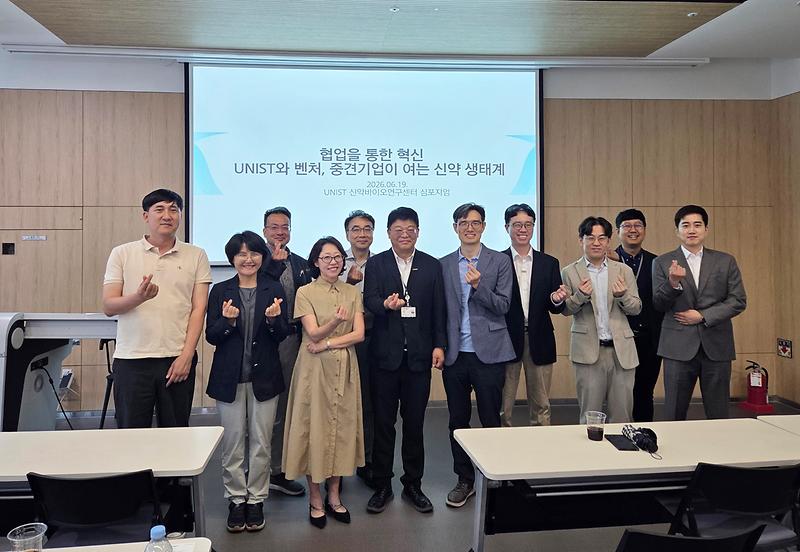
UNIST Brings Researchers and Industry Together to Advance Drug DiscoveryHeld on June 19, the symposium explored new partnerships connecting academic research with biotechnology startups and pharmaceutical companies.Developing new medicines increasingly depends on close collaboration between academia and industry. To strengthen those partnerships, UNIST hosted a symposium on June 19 exploring how universities, biotechnology startups, and pharmaceutical companies can work together to accelerate drug discovery. Hosted under the theme ' Innovation Through Collaboration ,' the symposium brought together faculty members from UNIST and key representatives from Hanlim Pharmaceutical, Sangmyung Innovation, Mothers Pharmaceutical, InsPharmTech, and SmartinBio. The event opened with welcome remarks from UNIST Vice President Hyun Sil Ahn of Research Affairs and congratulatory remarks from Jin Ha Park, Executive Vice President of Hanlim Pharmaceutical and CEO of Sangmyung Innovation. Presentations covered a wide range of emerging therapeutic technologies, including broad-spectrum antiviral therapies, targets for inflammatory aging, treatments for retinal diseases, ocular disease models, advanced drug delivery systems, and mitochondria-targeted therapeutics. Beyond highlighting scientific advances, discussions focused on how universities, startups, and established pharmaceutical companies can better combine their respective strengths in research, development, and commercialization. Participants explored ways to accelerate the translation of promising discoveries into new medicines while expanding opportunities for collaborative research. The symposium also highlighted the growing role of UNIST-based biotechnology startups in the regional biohealth sector. By working alongside established pharmaceutical companies, early-stage ventures can gain access to development expertise, commercialization pathways, and collaborative research opportunities that support long-term growth. “Drug discovery has become too complex for any single institution or company to tackle alone,” said Professor Jang Hyun Choi, Chair of the Department of Biological Sciences, who also directs UNIST's new drug bio research center. “Innovation happens when universities and industry combine their respective strengths in research and commercialization. We hope this symposium serves as a catalyst for new partnerships that accelerate drug discovery and strengthen Korea’s biopharmaceutical sector.” The symposium was jointly organized by the Department of Biological Sciences and UNIST's new drug bio research center, with support from SmartinBio and Hanlim Pharmaceutical.- 2026-06-25
- JooHyeon Heo
- 84
-
News
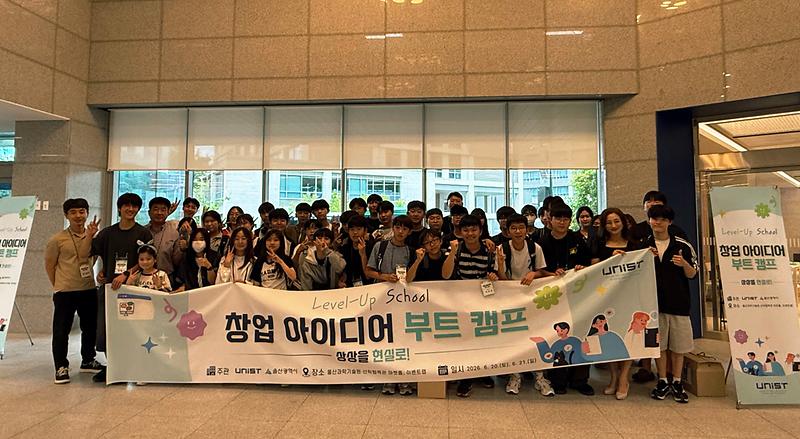
From Problem-Solving to Pitching: Students Experience Entrepreneurship at UNISTSixty middle and high school students developed and pitched business ideas through a hands-on entrepreneurship boot camp.Sixty middle and high school students from across Ulsan gathered at UNIST to experience the startup process firsthand—from identifying problems and testing ideas to pitching business concepts. Held on June 20–21 at the UNIST University-Industry Cooperation Building, the Level-Up School Startup Idea Boot Camp offered students a hands-on introduction to entrepreneurship through workshops, mentoring, and team-based projects. The program was jointly organized by UNIST and the Ulsan Metropolitan Office of Education. Rather than beginning with business plans, students started by identifying real-world problems. Working in teams, they examined everyday challenges, identified potential customers, evaluated existing solutions, and refined their ideas based on market needs. Generative AI tools were used throughout the program to conduct market research, compare competing products and services, and strengthen business concepts. Participants also used the technology to refine presentations and communicate their ideas more effectively. Students then organized their ideas using a Lean Canvas model, outlining customer needs, proposed solutions, revenue models, and competitive advantages. Entrepreneurship mentors provided feedback on market potential, business strategy, and areas for improvement. The boot camp concluded with the 'L Series Ideathon ,' where teams delivered three-minute investor-style pitches and received feedback from entrepreneurship experts. The program also served as preparation for the Korea Youth Entrepreneurship Competition, giving students experience in idea development, market research, business planning, and pitching. “Students had the opportunity to see how AI and entrepreneurship can come together to create new value,” said Director Youngsik Kim of University-Industry Relations at UNIST. “We hope experiences like this encourage young people to explore entrepreneurship and develop the skills needed to bring new ideas to life.”- 2026-06-23
- JooHyeon Heo
- 285
-
News
UNIST and Asan Medical Center Explore New Frontiers in Medical AIResearchers explored how clinical data and AI can support diagnosis, prediction, and personalized care.Artificial intelligence (AI) is creating new opportunities in healthcare, from helping doctors detect disease earlier to anticipating complications and tailoring treatments to individual patients. Yet turning clinical data into tools that can support real-world medical decisions remains a significant challenge. On June 16, researchers from UNIST and Asan Medical Center came together to discuss how advances in AI, data science, and clinical medicine can help bridge that gap. A recurring question throughout the discussions was how AI can help clinicians make better decisions in complex healthcare settings. Researchers shared work on digital pathology, critical care analytics, predictive modeling, and other approaches aimed at turning clinical data into actionable insights for patient care. More than 40 researchers and clinicians from UNIST and Asan Medical Center participated in the discussions, bringing together expertise in AI, biomedical engineering, computer science, and clinical medicine. Topics ranged from disease diagnosis and prognosis to patient monitoring and treatment planning. Several presentations highlighted areas where AI is beginning to show promise in clinical practice, including the analysis of data generated in operating rooms and intensive care units, digital pathology for disease detection, and predictive models designed to anticipate patient outcomes. Researchers also discussed digital twin approaches that could help simulate disease progression and support more personalized treatment strategies. A recurring theme throughout the event was the importance of defining meaningful clinical problems before developing technical solutions. Participants emphasized that successful medical AI depends not only on stronger algorithms, but also on close engagement with clinicians who understand the realities of patient care. The discussions also highlighted how the two institutions bring different capabilities to the partnership. UNIST continues to expand its capabilities in large-scale medical data analysis through advanced AI research and high-performance computing resources. Asan Medical Center, meanwhile, is developing an Integrated Data Platform (IDP) to support the secure and efficient use of clinical data for research. Since launching their partnership earlier this year, the two institutions have been exploring new opportunities for researcher exchange and joint projects that combine clinical expertise with advances in artificial intelligence. Areas of interest include digital pathology, critical care analytics, and predictive models that can help doctors make more informed decisions and deliver more personalized care. “This gathering provided an opportunity to connect UNIST's strengths in artificial intelligence and data science with Asan Medical Center's clinical expertise,” said Dean Seungjae Baek of UNIST Graduate School of Health Science and Technology. “By bringing researchers together around real challenges in healthcare, we hope to develop research that can ultimately improve patient outcomes.” Dong Hyun Yang, Director of the AI Innovation Support Office at Asan Medical Center, said, “Combining extensive clinical data with advanced AI technologies creates new opportunities to address complex challenges in healthcare. We look forward to expanding research that supports more accurate predictions, better clinical decision-making, and increasingly personalized patient care.”- 2026-06-23
- JooHyeon Heo
- 272
-
News
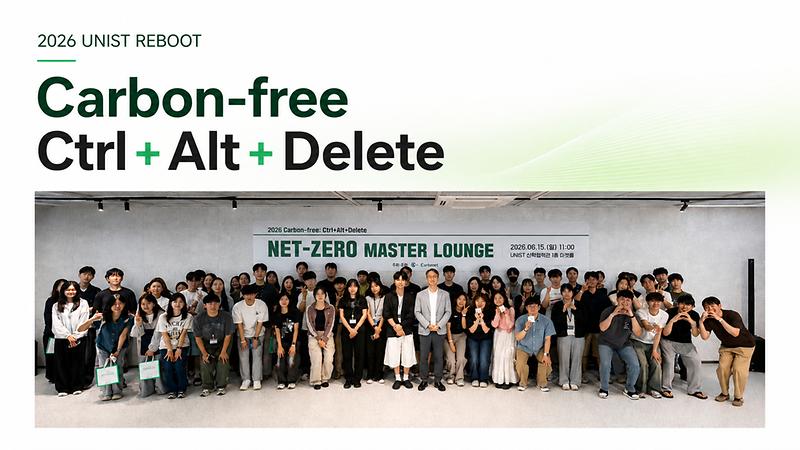
UNIST Students Turn Everyday Habits into Climate Action Through REBOOT 2026More than 180 students joined a weeklong sustainability challenge, with 87 earning Net-Zero Master recognition.“What does carbon neutrality look like in everyday life?” For five days in June, students at UNIST explored that question through a campus-wide challenge focused on practical climate action. Held from June 1 to 5 in conjunction with World Environment Day, the 2026 UNIST REBOOT: Carbon-free Ctrl+Alt+Delete campaign brought together 180 students for a week of sustainability-focused activities. By the end of the challenge, 87 participants had completed every mission and earned recognition as Net-Zero Masters. The theme, ' Carbon-free Ctrl+Alt+Delete ,' used the familiar computer command as a metaphor for replacing carbon-intensive habits with more sustainable ones. The campaign encouraged students to view carbon neutrality not as a distant goal, but as something shaped by everyday choices. Students participated individually and as members of eight Green Squad teams, where individual actions contributed to team results. The campaign also reflected its sustainability message in practice, relying entirely on digital promotion rather than printed materials. The week concluded with the Net-Zero Master Lounge , a gathering that recognized students who completed the full program. Participants received commemorative items marking their achievements, including personalized keepsakes created by the Graduate School of Carbon Neutrality. The UNIST Graduate School of Carbon Neutrality also plans to recognize the 87 Net-Zero Masters through a Hall of Fame on its website, while continuing to expand programs that encourage sustainable practices across campus. “World Environment Day provided an opportunity to see members of the UNIST community put carbon neutrality into practice in meaningful ways,” said Dean Yongwon Seo of the Graduate School of Carbon Neutrality. “We hope experiences like this help demonstrate that sustainability is not a distant goal, but something that can be incorporated into everyday life.”- 2026-06-23
- JooHyeon Heo
- 310
-
News
UNIST Rises in QS World University Rankings 2027 as Reputation Gains MomentumUNIST ranks No. 299 worldwide and No. 8 in South Korea, with citations per faculty remaining among the world's strongest.UNIST's global standing continues to rise, as strong research impact and growing international recognition lifted the university to No. 299 worldwide in the QS World University Rankings 2027 , released on June 18, 2026. UNIST climbed 11 places from the previous year, supported by one of the world's strongest scores in Citations per Faculty and clear gains in both Academic Reputation and Employer Reputation. The results suggest that UNIST's research profile, long reflected in citation-based measures, is now gaining wider recognition among scholars and employers worldwide. Published annually by QS Quacquarelli Symonds, the QS World University Rankings is one of the most widely followed global university assessments. This year, QS assessed 8,808 institutions and ranked 1,504 universities worldwide. In South Korea, 43 universities were included. Reputation played a central role in UNIST's rise. In the QS methodology, Academic Reputation accounts for 30 percent of the overall score, while Employer Reputation accounts for 15 percent. UNIST moved up 72 places in Academic Reputation and 19 places in Employer Reputation from the previous year. For a young research university, that shift is significant. UNIST has built a strong record in research output and citation impact, but reputation often takes longer to develop. This year's results point to a narrowing gap between the university's research performance and how it is perceived internationally. UNIST continued to demonstrate exceptional research competitiveness in the 2027 rankings. The university placed No. 32 worldwide in Citations per Faculty and No. 100 worldwide in Faculty Student Ratio . Furthermore, its Citations per Faculty score reached 99.3 out of 100, reflecting the global visibility and influence of its research output. Research impact remains one of UNIST's clearest strengths. In the 2027 rankings, the university placed No. 32 worldwide in Citations per Faculty , earning a score of 99.3 out of 100. It also ranked No. 100 worldwide in Faculty Student Ratio , reflecting a strong academic environment for students and researchers. UNIST's research strength is also evident in other major international rankings. In the Nature Index 2026, the university rose 28 places from the previous year. In the CWTS Leiden Ranking 2025, UNIST ranked No. 1 in South Korea for the ninth consecutive year. While the Leiden Ranking focuses on citation-based measures of research quality, the Nature Index tracks contributions to a select group of leading scientific journals. Together, the results show the consistency and reach of UNIST's research. This year's QS results came in a more competitive ranking landscape. The number of institutions assessed by QS has grown sharply, from 1,673 in the 2022 rankings to 8,808 in the 2027 rankings. Since 2024, QS has also added indicators, such as International Research Network (IRN), Employment Outcomes, and Sustainability, broadening the way universities are measured. Against that backdrop, UNIST improved its global position while maintaining its strength in research impact. The gains in academic and employer reputation add another signal: the university's work is becoming more visible to the communities that shape global higher education. “UNIST's rise in this year's QS rankings reflects the growing visibility of our research and the strength of the academic and industry networks we have built,” said President Chong Rae Park of UNIST. “We will continue to support research that advances knowledge, prepare outstanding graduates, and contribute to society through science and technology.” UNIST will continue to build on its strengths in research and education as it expands its role as one of South Korea's leading science and technology universities.- 2026-06-19
- JooHyeon Heo
- 1441
-
News
UNIST Brings Citizen-Led Solutions for Shrinking Cities to EU ForumProfessor Seungho Park-Lee joined the NEB Festival 2026 as the only speaker from a Korean university, highlighting citizen-led urban transition projects in Miryang and Andong.“How can cities adapt when populations shrink and communities age?” That question brought UNIST to Brussels this month, where Professor Seungho Park-Lee of the Department of Design and Center for Anticipatory Urban Strategy joined policymakers and urban experts at the New European Bauhaus (NEB) Festival 2026 , the European Union's flagship initiative for sustainable and inclusive living environments. Held from June 9–13 at the Art & History Museum and Parc du Cinquantenaire in Brussels, this year's festival centered on the theme " Life, Spaces, Buildings ” and explored how communities can shape more resilient and affordable places to live. Professor Park-Lee was the only speaker from a Korean university invited to participate in the festival's official forum program. On June 11, he joined the panel “From Participation to Self-Sufficiency: Designing Democratic, Climate-Ready Communities,” where he presented citizen-led urban transition projects carried out in the Korean cities of Miryang and Andong with colleagues at UNIST. The projects address challenges familiar to many regions in Korea and beyond: population decline, aging societies, and changing living conditions. Instead of relying solely on expert-driven planning, residents were invited to identify local issues and help shape policy responses. The work treats local knowledge and lived experience not as consultation after the fact, but as the starting point for urban transformation. The session brought together experts from across Europe, including Portugal, Belgium, and Sweden, to discuss democratic governance, climate resilience, and regional self-reliance. Drawing on the Miryang and Andong cases, Professor Park-Lee argued that citizen participation is not simply a democratic ideal but a practical condition for lasting urban change. Professor Park-Lee also took part in the festival's closing panel on June 12, which reflected on the future direction of the New European Bauhaus initiative. The discussion was moderated by Ruth Reichstein, Cabinet member to European Commission President Ursula von der Leyen and one of the initiative's leading architects. During the session, Professor Park-Lee noted that the principles at the heart of the New European Bauhaus—sustainability, inclusivity, and beauty—offer a useful framework for addressing many of the social and demographic challenges facing Korea. He also suggested exploring connections with the World Design Capital Busan 2028, highlighting opportunities to link global design agendas with local urban transformation. UNIST's participation in the forum reflects the growing international relevance of research rooted in local challenges. The pressures confronting regional cities in Korea are increasingly shared elsewhere, including across Europe. As governments search for ways to respond to demographic change, the experiences of cities such as Miryang and Andong offer insights into how communities themselves can help shape their futures. Professor Park-Lee has previously contributed to NEB initiatives at the invitation of the European Commission. In 2025, he participated in an international panel at the EU Pavilion during Expo 2025 Osaka alongside Professor Gihyoug Cho of the Department of Civil, Urban, Earth, and Environmental Engineering. He chaired the session “NEB Goes to Osaka: Shaping Urban Futures—Design, Technology & Democracy,” which explored how architecture and urban planning can support democracy, resilience, and social cohesion. The event featured a keynote address by Henna Virkkunen, European Commission Executive Vice-President for Tech Sovereignty, Security and Democracy. “The New European Bauhaus is an important international platform for exploring how design, technology, and citizen participation can work together to address challenges such as climate change and demographic change,” said Professor Park-Lee. “The issues facing regional cities in Korea—population decline, populations aging, and changing living environments—are challenges shared by many communities in Europe as well.” He further added, "This forum allowed us to connect the work taking place in Miryang and Andong with broader international discussions on sustainable transitions. We hope UNIST's design research can continue to offer practical approaches that connect technology, policy, and communities."- 2026-06-17
- JooHyeon Heo
- 2256
-
News
UNIST Hosts 2026 Korea Industrial AI Forum to Advance Manufacturing TransformationIndustry leaders and researchers discuss practical strategies for accelerating AI adoption in manufacturing.UNIST brought together leaders from industry and academia to explore the future of artificial intelligence (AI) in manufacturing at the 2026 Korea Industrial AI Forum , held on June 9 at the Peace & Park Convention Royal Hall in Seoul. The forum was jointly organized by UNIST, the Korea Industrial Technology Association (KOITA), LS ELECTRIC, LG AI Research, and POSCO Holdings under the theme "Designing the Manufacturing AI Advantage in the Era of AI Transformation." More than 200 participants attended to discuss strategies for deploying AI in manufacturing, industry applications, and collaboration models to strengthen industrial competitiveness. In opening remarks, Vice President Hyun Sil Ahn for Research Affairs at UNIST noted that AI is evolving beyond generative systems toward technologies capable of autonomous decision-making and interaction with the physical world. “AI is no longer an optional technology—it has become essential infrastructure for industrial competitiveness,” said Vice President Ahn. “The challenge is not how much AI an organization possesses, but how effectively it can apply AI to create industrial value.” The keynote address was delivered by WooHyung Lim, Head of LG AI Research, who introduced the company's AI strategy and industrial applications under the theme “ The Industrial Ecosystem Evolving Through AI .” The first session, “ Korean Manufacturing AI 2030: Strategy and Execution ,” focused on pathways for accelerating AI adoption across manufacturing industries. Boseon Yu, Chief Technology Office of INEEJI , presented strategies for AI-driven manufacturing innovation, while YoungOk Kim, Executive Director of HD Hyundai, shared the company's experience implementing AI technologies in industrial settings. INEEJI, founded by Professor Jaesik Choi during his tenure at UNIST, specializes in industrial data analytics and manufacturing process optimization. Its participation highlighted how university-based AI research can translate into practical industrial solutions. The forum also highlighted UNIST's collaboration with HD Hyundai in advancing AI transformation in shipbuilding. UNIST currently leads the shipbuilding component of the Ministry of Science and ICT's national initiative for large-scale industrial AI research in partnership with HD Hyundai Heavy Industries, HD Korea Shipbuilding & Offshore Engineering, and CrowdWorks. Supported by KRW 40.3 billion in funding, the initiative aims to develop multimodal AI foundation models that integrate design, production, quality-control, video, and sensor data generated across shipbuilding operations, while validating these technologies in real industrial environments. The second session, “AI Transformation in Industrial Settings,” featured Young-Sin Heo, Chief Business Officer (CBO) at MakinaRocks Co. Ltd., who discussed the emerging impact of agentic AI in manufacturing, and Vice President Hyundong Lee of Superb AI Inc., who examined key requirements for implementing physical AI technologies in industry. The forum concluded with a panel discussion examining one of the central questions facing industry today: how to bridge the gap between AI strategy and implementation. Participants emphasized that sustained collaboration among universities, technology developers, and manufacturers will be critical to ensuring that advances in AI translate into tangible industrial outcomes. “Manufacturing AI will be a defining driver of Korea’s industrial competitiveness,” Ahn said. “UNIST remains committed to advancing AI transformation through collaborative research with industry, large-scale demonstrations, and the cultivation of AI talent equipped to address real-world challenges.”- 2026-06-15
- JooHyeon Heo
- 2508
-
News
UNIST–Fraunhofer Composite Materials Research Partnership Renewed for Third Five-Year TermThe new five-year term will support expanded research, industry collaboration, and workforce development between UNIST and Fraunhofer ICT.The Fraunhofer Innovation Platform for Composites Research@UNIST (FIP-Composites@UNIST) has secured a third five-year term from Germany's Fraunhofer-Gesellschaft following a successful review by Fraunhofer headquarters. The renewal recognizes the center's contributions to composite materials research, industry engagement, and international cooperation, and will support expanded research and training activities over the next five years. Established in 2016 through a partnership between UNIST and the Fraunhofer Institute for Chemical Technology (Fraunhofer ICT), FIP-Composites@UNIST conducts research in lightweight structures, advanced manufacturing, composite recycling, structural health monitoring, and AI-enabled predictive maintenance. Professor Young-Bin Park from the Department of Mechanical Engineering at UNIST serves as director of the center. During its first two phases (2016–2025), FIP-Composites@UNIST established dedicated research facilities and advanced manufacturing and testing capabilities while supporting international research projects, researcher exchanges, and technology development for the Korean industry. Through its partnership with Fraunhofer ICT, the center has built an international research network in composite materials and helped connect Korean companies with advanced manufacturing expertise from Germany. These achievements contributed to the center's successful evaluation by Fraunhofer headquarters and the approval of a third five-year term. Led by Professor Young-Bin Park of the Department of Mechanical Engineering, the center will continue advancing research in composite materials and manufacturing technologies while strengthening industry partnerships and expanding training opportunities for students and researchers. The renewal coincided with the recent FIP in Korea Networking program, which brought together representatives from Fraunhofer headquarters, German research institutes, and Korea-based Fraunhofer Innovation Platforms. UNIST hosted the program's second day, where participants discussed ways to expand cooperation across Fraunhofer's Korean network. “UNIST has demonstrated strong achievements in international research cooperation,” said Frauke Mickler, Program Manager for International Research Collaboration at Fraunhofer-Gesellschaft. “We hope FIP-Composites@UNIST will continue to serve as a leading model for Fraunhofer's international partnerships worldwide.” UNIST President Chong Rae Park welcomed the renewal and reaffirmed the university's commitment to the partnership. "This renewal reflects the strength of the partnership that UNIST and Fraunhofer have built together,” said President Park. “We look forward to expanding joint research and creating new opportunities for researchers, students, and industry partners in the years ahead.- 2026-06-10
- JooHyeon Heo
- 2672
-
News
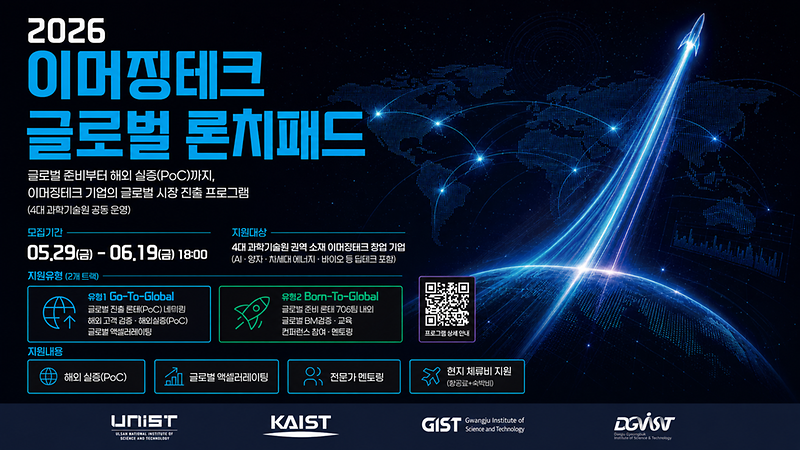
Four Science and Technology Institutes Launch Global Program for Deep-Tech StartupsThe 2026 Emerging Tech Global Launchpad will help startups test technologies, connect with international partners, and accelerate overseas growth.
For many deep-tech startups, the greatest challenge is not developing a technology—it is proving that technology can succeed in a global market. A new initiative led by UNIST, KAIST, GIST, and DGIST aims to help bridge that gap. Supported by the Ministry of Science and ICT (MSIT), the '2026 Emerging Tech Global Launchpad' will provide Korean startups with opportunities to validate technologies overseas, engage potential customers and investors, and build connections in major innovation hubs around the world. Applications are open from May 29 through June 19, 2026. The program is designed for startups developing emerging technologies in areas such as artificial intelligence, quantum technologies, advanced energy, and biotechnology. Rather than offering a one-size-fits-all approach, the initiative will provide tailored support based on each company's stage of global development. Startups already exploring international markets may participate in the Global Expansion Track, which focuses on overseas proof-of-concept (PoC) projects. Through partnerships with local organizations and industry experts, companies will have opportunities to test technologies in real-world settings and assess their commercial potential. The Global Readiness Track is intended for startups preparing for international growth. Participants will receive focused support in areas including customer discovery, market-entry strategy, commercialization planning, and investment readiness. Beyond training and mentoring, selected companies will also gain access to major international technology conferences and startup events in innovation centers such as the United States and Singapore. These opportunities are expected to help founders connect directly with potential customers, investors, and industry partners while exploring new markets. The program will operate through the regional startup networks of Korea's four science and technology institutes. UNIST will support companies in the Southeast region, KAIST in Central Korea, GIST in the Honam region, and DGIST in the Daegu-Gyeongbuk region. Founders affiliated with any of the four institutes may apply through their home institution regardless of company location. “By bringing together the strengths of Korea's leading science and technology institutes, we hope to create a practical pathway for deep-tech startups seeking opportunities beyond Korea,” said UNIST President Chong Rae Park. “Our goal is to help promising companies validate their technologies, build international partnerships, and compete with confidence in global markets.” The 2026 Emerging Tech Global Launchpad expands a partnership already established through GRAVITY 2026, the joint student startup league for research-driven deep-tech ventures operated by the four S&T institutes. While GRAVITY 2026 focuses on student entrepreneurship, the new initiative extends support to emerging technology companies pursuing overseas customer validation and market entry. Additional information, eligibility requirements, and application details are available through the official websites of 2026 Emerging Tech Global Launchpad and the UNIST Office of University Industry Relations.- 2026-06-04
- JooHyeon Heo
- 3593